Showing posts with label Law and the Judiciary. Show all posts

Case before Supreme Court may offer preview of what is to become of Proposition 8

Friday, October 15, 2010

The City Council of the District of Columbia legalized same-sex marriage last December. Ever since, a coalition of social conservatives and religious groups have been working to bring the issue before the voters to decide, citing a provision of the City Charter which grants citizens of the District the right to hold a referendum on anything except "laws appropriating funds." Over the past year the effort has faced setbacks in both the Legislative and Judicial branches of government.

Bishop Harry Jackson of the Hope Christian Church
and leader of StandForMarriageDC, who I had an
opportunity to meet and work with twice during the
2010 Summer for Marriage Tour in Annapolis and D.C.
First, the coalition, which goes by the name "StandForMarriageDC", and is led by Bishop Harry Jackson, sued the District after the D.C. Board of Elections refused to grant them permission to hold a referendum to define marriage.

According to the Board of Elections, such referendum would have violated the city's Human Rights Act.

In January, 2010 the D.C Superior Court agreed with the Board of Elections and upheld their decision.

Congress had refused to intervene on the matter during their 30-day congressional review period, which they have over the city's affairs. Congress even has the ability to bypass the local city government altogether to pass legislation of their own. As a result, the same-sex marriage law went into effect on March 3, 2010.

Although Chief Justice John Roberts said Bishop Jackson's argument "has some force", he opted not to issue an emergency stay which would have put same-sex marriage on hold, at least temporarily. A full version of Justice Robert's decision can be read here.

Utah Senator Bob Bennett, facing a tough primary challenge from Tea Party favorite Mike Lee, tried in March to add an amendment to the health care reform legislation that would have prohibited the city from issuing marriage licenses to same-sex partners until the voters had a chance to weigh in on the matter. The Democrats were ultimately able to kill that amendment.

The next setback came in July right as the National Organization for Marriage was kicking off its 2010 Summer for Marriage Tour. StandForMarriageDC had appealed the January ruling from the D.C. Superior Court to the D.C. Court of Appeals, where in a 5-4 ruling, the Court affirmed that a referendum on the definition of marriage would violate the city's Human Rights Act.

Since then we've seen Proposition 8 ruled unconstitutional by a federal judge in San Fransisco. We've seen part of the Defense of Marriage Act ruled unconstitutional by a federal judge in Boston. We also saw a very powerful rally in front of the U.S. Capital to wrap up the Summer for Marriage Tour.

In the video below, you can see Bishop Harry Jackson leading the people in a rally chant of  "Let the people vote, Let the people vote, Let the people vote".


There is no question that this issue is headed to the Supreme Court and most likely to be heard is the Perry v. Schwarzenegger case out of San Fransisco, which on appeal to the 9th Circuit Court of Appeals and set to kick-off in December. Much of the debate, however, centers on how the Supreme Court will rule in Perry.

On both sides people agree that four justices will affirm the right of same-sex marriage (Kagan, Sotomayor, Ginsberg and Breyer) while four will almost certainly affirm traditional marriage (Roberts, Alito, Scalia and Thomas) as something worthy of preserving and something the government has a legitimate state interest in regulating. That leaves Justice Kennedy as the swing vote.

The only debate lies in which way Kennedy will vote. Justice Kennedy wrote the majority opinion in Lawrence v. Texas, a historically significant Supreme Court case that ultimately struck down anti-sodomy laws in various states across the Nation.

However, in his opinion, Kennedy did not offer too much insight into how his legal mind reacts to the notion of governmental recognition of same-sex relationships. He wrote:

The statutes do seek to control a personal relationship that, whether or not entitled to formal recognition in the law, is within the liberty of persons to choose without being punished as criminals.

In this Kennedy affirms the right of homosexual and heterosexuals alike to engage in sexual activities, which he calls "the most private human conduct" as they please. But he glosses over the issue of relationship recognition which was not at issue in this case.


There is part of his opinion, however, which is particularly interesting given the discourse on the topic of homosexuality in today's society. It also brings more light into which way Kennedy may swing in the Perry case. He continued:

This, as a general rule, should counsel against attempts by the State, or a court, to define the meaning of the relationship or to set its boundaries absent injury to a person or abuse of an institution the law protects.
The last clause of that sentence is what is interesting. Kennedy points out that, while the State (or a court) ought not to regulate the boundaries of a relationship, he implies that such regulation is possible or even perhaps necessary, when a person is injured or more importantly, an institution the law protects is injured.

Marriage being in many ways an extension - or expansion of the boundaries of a relationship, it could be argued that the institution of marriage is one of those institutions protected by the law that may be "injured" as a result of the legalization of same-sex marriage.

At the very least, Kennedy acknowledged that circumstances may exist when it maybe necessary to define the boundaries of a relationship and that is critical as we move forward. This is particularly critical given Justice Kennedy's comments on the homosexual relationship in general:

It suffices for us to acknowledge that adults may choose to enter upon this relationship in the confines of their homes and their own private lives and still retain their dignity as free persons.

First off, Kennedy wrote here that entering into a homosexual relationship is a choice. Secondly, he acknowledged that a private relationship between two people of the same sex taking place within the confines of their own homes is enough for one to "retain their dignity as a free person".

This is important as marriage is a public contract, not private, and homosexual activists claim the denial of marriage to same-sex couples is demeaning to their dignity and makes them second-class citizens.

It appears, unless Justice Kennedy has changed his mind, that the decriminalization of homosexuality so that to enter into an intimate homosexual relationship at your heart's desire ought to be enough for one to retain one's dignity as a free person.

Still, having taken all this into account, forecasting the Supreme Court's potential ruling in Perry is not entirely possible. After all, although most proponents of same-sex marriage count Justice Elena Kagan as safely in their corner, it was she don't forget, who said there is no right to same-sex marriage in the Constitution during her confirmation hearings. She is likely to vote for same-sex marriage but that is something to keep in mind.

So quite possibly one of the best forecasters we can use to "judge the judges" on this matter surrounds a petition, Jackson v. D.C., filed by StandForMarriageDC to the Supreme Court to appeal the negative ruling they received from the DC Court of Appeals in July.

If the Court agrees to hear the case, they will be hearing a case very similar to but substantially different from the Perry case. The two cases are similar in that they surround the issue of the right of citizens to vote on the definition of marriage via ballot initiative or referendum.

They are substantially different in that the Perry case will tackle the issue of a ballot initiative approved by the voters and then struck down while the petition from StandForMarriageDC will ask the Court to affirm the right of DC's citizens to vote in the first place.

Even a narrow ruling in this case out of DC, (if the Court agrees to hear it) would shed light onto the prospects of the Perry case. It is difficult to see the Supreme Court affirming the right of DC's citizens to vote on the definition of marriage, although many contend it violates the city's Human Rights Act, and then turn around and deny the right of Californians to do essentially the same thing.

Another possibility is that the Supreme Court won't hear the case and thus won't issue a ruling and we'll be left in the dark to merely speculate how Justice Kennedy's legal mind has evolved, if at all, over the past 7 years since Lawrence v. Texas.
READ MORE - Case before Supreme Court may offer preview of what is to become of Proposition 8

Does Wisconsin's domestic partnerships law violate the state's constitution?

Friday, October 8, 2010


In 2009 the Wisconsin Supreme Court ruled against a challenge to the state’s domestic partnership law enacted three years after over nearly 2/3rds of Wisconsinites passed Referendum 1, which reads as follows:

Only a marriage between one man and one woman shall be valid or recognized as a marriage in this state. A legal status identical or substantially similar to that of marriage for unmarried individuals shall not be valid or recognized in this state.

Wisconsin Family Action, a pro-family, traditional marriage group with whom I worked with during the National Organization for Marriage’s Summer for Marriage Tour stop in Madison, WI this summer challenged the legality of the domestic partnership registry as in their opinion; it was substantially similar to that of marriage.

Wisconsin banned same-sex marriage
in 2006 with Referendum 1.
Today the same pro-family group is putting forth a second challenge to the registry for same-sex couples on the same grounds: The domestic partnership registry is too similar to marriage and violates the state law created by passage of Referendum 1.

This time the challenge comes only months after the State Supreme Court ruled unanimously to uphold the constitutionality of that very referendum, which was challenged by a political science professor on a technicality that it violated the state’s laws on referendums by posing two questions in one referendum.

So the question is whether or not Wisconsin’s Domestic Partnership law is substantially similar to marriage or not and so I’d like to put forth the information to compare the two and let you decide.

Besides the fact that the applications for a marriage licenses and the application for domestic partnerships are both obtained from the County Clerk, the similarities between the two don’t stop at that.

Wisconsin state statute 765.01 states that “Marriage, so far as its validity at law is concerned, is a civil contract, to which the consent of the parties capable in law of contracting is essential, and which creates the legal status of husband and wife.”

In the declaration of policy for the state’s domestic partnership law, the state states the following:

The legislature finds that it is in the interests of the citizens of this state to establish and provide the parameters for a legal status of domestic partnership.

So what’s the difference between the two? The marriage law seems to specify husband and wife but besides that the two civil contracts create a “legal status” between two people. I’m quite sure that when the Wisconsin State Legislature drafted its first marriage laws, it found that it was “in the interests of the citizens of this state to establish and provide the parameters” of such legal status, too.

Moving along. Wisconsin state statute 765.02(1) states that “Every person who has attained the age of 18 years may marry if otherwise competent.”

Wisconsin’s domestic partnership has a similar requirement. Two individuals may form a domestic partnership if they satisfy all of the following criteria:


(1) Each individual is at least 18 years old and capable of consenting to the domestic partnership.

So in marriage and domestic partnerships, both parties have to be at least 18 years of age. The law stipulates that both parties are “competent” for marriage and “capable of consenting” for domestic partnerships. No big differences there. Note: The above only shows one of the criteria for a domestic partnership; I’ll go through the rest now.

Next we move on to other issues of eligibility. For example, the issue of whether or not either of the aspiring marriage applicants are currently married – or if the person they want to marry is a close-blood relative. 

Well, as you would expect, Wisconsin state statute 765.03 states that “No marriage shall be contracted while either of the parties has a husband or wife living, nor between persons who are nearer of kin than 2nd cousins…”

Wisconsin’s domestic partnership law has similar wordage:

(2)    Neither individual is married to, or in a domestic partnership with, another individual.
(4)    The 2 individuals are not nearer of kin to each other than 2nd cousins, whether of the whole or half blood or by adoption.
Above criteria 2 and 4 are mirror images of Wisconsin’s marriage law, going so far as to bring in the specificity about one’s second cousin. Look at the fourth criteria closely. It is almost as though they copy and pasted the marriage law. They both have the awkwardly sounding “nearer of kin than…” in reference to the second cousins.

Criteria three of the eligibility requirements for entering into a domestic partnership at first appeared to be a difference between the two. But honestly speaking, a criterion that you live together (literally “share a common residence” in the partnership law) goes without saying for marriage. I mean, it’s what married couples do. They live together. They have families. So there’s no difference there, either.

Criterion number five of the domestic partnership law is where a significant difference between marriage and domestic partnership sticks out like a car with five wheels. Criterion number five requires that both parties applying for a domestic partnership be of the same sex.

What? The first thing I thought was what about heterosexuals? How can, on one hand, the LGBT community be campaigning across the country against marriage laws which exclude same-sex couples but on the other hand support this domestic partnership law with excludes opposite sex couples?

It doesn’t matter that marriage may be ‘better’. Quite surely it is, to some. But shouldn’t opposite sex couples have the right to enter into a domestic partnership with their partner? What if they don’t like marriage? What if they were married once, got divorced and swore they’d never get married again, only to find and fall in love with someone else down the road?

I’ll have to revisit this issue later on. For now I want to continue comparing (there’s really not much contrasting going on, if you’ve noticed) marriage and Wisconsin’s domestic partnership law.

Wisconsin state statute 765.08(1) states that: “Except as provided in sub. (2), no marriage license may be issued within 5 days of application for the marriage license.”

That’s funny because I read that same thing in the domestic partnership law.

Except as provided in subd. 2., the county clerk may not issue a declaration of domestic partnership until at least 5 days after receiving the application for the declaration of domestic partnership.

Guess what? Subsection 2 is also very similar between the two laws.

Subsection 2 for the marriage law reads:

The county clerk may, at his or her discretion, issue a marriage license within less than 5 days after application if the applicant pays an additional fee of not more than $25 to cover any increased processing cost incurred by the county. The county clerk shall pay this fee into the county treasury.

Subsection 2 for the domestic partnership law reads:

The county clerk may, at his or her discretion, issue a declaration of domestic partnership less than 5 days after application if the applicant pays an additional fee of not more than $10 to cover any increased processing cost incurred by the county. The county clerk shall pay this fee into the county treasury.

Now that’s as word-for-word as it gets, folks. Oh, minus the extra fifteen dollars a couple seeking to get married must pay for expedited services. Please don’t tell me the difference between marriage and domestic partnership in Wisconsin lay in that little difference.

Wisconsin state statute 765.09(2) reads: “No marriage license may be issued unless the application for it is subscribed by the parties intending to intermarry, contains the social security number of each party who has a social security number and is filed with the clerk who issues the marriage license.”

Would it surprise you to find out that the domestic partnership law is a mirror image of that, too? I would hope that by this time, it would not be a surprise.

No declaration of domestic partnership may be issued unless the application for it is subscribed to by the parties intending to form the domestic partnership; it contains the social security number of each party who has a social security number; and it is filed with the clerk who issues the declaration of domestic partnership.

This is getting quite redundant, due to the fact that marriage and domestic partnership in Wisconsin are one in the same, so I’m going to pick up the pace a little. I’m going to lay out the facts and then the game will be to see if at the end of this article, you can, with a straight face, say that marriage and domestic partnerships in Wisconsin are “substantially different” as the law requires.

The marriage and domestic partnership laws both require that both parties “shall present satisfactory, documentary proof of identification and residence and shall swear to or affirm the application before the clerk who is to issue [it]. This is from Wisconsin state statute 765.09(3a).

Both the marriage and domestic partnership laws require that the respective application “shall contain the social security number of each party, as well as any other informational items,” that some government office may require. This is from the same Wisconsin state statute above.

That state statute goes on to finish “The portion of the marriage application form that is collected for statistical purposes only shall indicate that the address of the marriage license applicant may be provided by a county clerk to a law enforcement officer under the conditions specified under s. 765.20 (2).” And of course, word-for-word, with the replacement of “marriage license” with “application [for a domestic partnership]”, the domestic partnership law says the same thing. Word for word.

According to both marriage law and the domestic partnership law, both couples “must submit a certified copy of their birth certificate” but the law provides an out for both couples if a certified copy of their birth certificate is “unobtainable”. In such a case, both the couple applying for a marriage license and a couple applying for a domestic partnership may submit “other satisfactory documentary proof” of the requisite facts.

And what if the county clerk is not satisfied with the documentary proof provided? Well in that case, law stipulates that for both marriage and domestic partnership applications, the following: “Whenever the clerk is not satisfied with the documentary proof presented, he or she shall submit the presented proof to a judge of a court of record in the county of application for an opinion as to its sufficiency.”

So far the differences between marriage and domestic partnership in Wisconsin are the fact that 1) marriage is between a male and female and a domestic partnership is between two people of the same sex and 2) a more expensive fee for expedited services if you want to get married. Substantially different or substantially the same?

Not only are the fees to obtain a marriage license and to enter into a domestic partnership, but the way in which the money must be used by the County are identical for marriage applicants and domestic partnership applicants. Well, the domestic partnership law actually says it best:

770.17 Fees to county clerk. Each county clerk shall receive as a fee for each declaration of domestic partnership issued and for each certificate of termination of domestic partnership issued the same amount that the clerk receives for issuing a marriage license under s. 765.15. Of the amount that the clerk receives under this section, the clerk shall pay into the state treasury the same amount that the clerk pays into the state treasury from the fee collected for issuing a marriage license. The remainder shall become a part of the funds of the county. For each declaration of domestic partnership issued and for each certificate of termination of domestic partnership issued, the clerk shall also receive a standard notary fee in the same amount that the clerk receives as a standard notary fee in connection with issuing a marriage license and that may be retained by the clerk if the clerk is operating on a fee or part−fee basis but which otherwise shall become part of the funds of the county.

Information about the state’s domestic partnership law used in this article was obtained here.

Moving beyond the basically identical procedures of obtaining a marriage license and entering into a domestic partnership, it is necessary to go into differences in what benefits are available to domestic partnership couples versus married couples.

Bill 75 from the 2009 Wisconsin General Assembly contains a table of contents on page 6 that outlines the benefits granted to same-sex couples who enter into domestic partnerships.

These benefits include, but are not limited to, victim notification by the Department of Corrections, ownership of property and joint tenancy, health care, power of attorney, consent to autopsies, family and medical leave, and death benefits, among others. The full list can be seen here.

Most importantly, the list of benefits granted to couples in domestic partnerships is categorized by the authors of that very bill as “fairly extensive”. Altogether there are 27 areas of benefits granted.

The authors then go onto point out that there are some areas of family-relationship rights the domestic partnership law does not include. That list is on page 7 of the same Bill 75 and contains 22 areas of benefits not granted.

Altogether there are some 49 areas, or categories of benefits granted to married couples. Couples registered as domestic partnerships have access to 27, or 55% of them. But that is not actually really fair.

After all, two of the areas of “benefits” of family-relationship rights not afforded under the domestic partnership law are under the categories “marriage procedures” and “divorce”. That means same-sex couples have access to 57% of those benefit coverage areas.

Upon stating it’s opinion that the domestic partnership law was not “substantially similar” to marriage, the Legislative Council Staff, charged with the task of assessing whether or not the state’s domestic partnership law was or wasn’t “substantially similar”, the Council had this to say:

However, as noted previously, it cannot be concluded with certainty that a court would draw the same conclusions about the intent of art. XIII, s. 13 or the application of that provision to the domestic partnership proposal. Some uncertainty is inherent in attempting to determine how a court will interpret a constitutional amendment.

So you make the decision. Wisconsin’s same-sex domestic partnership law not only has almost identical procedures and eligibility requirements, but the legal status established through a domestic partnership offers nearly 6-out-of-10 of the benefits afforded to married couples and the domestic partnership status also affects how the couple can file taxes, just like it affects married couples.

The only differences between them, as I pointed out earlier, seem to be a difference in the cost of expedited services, the fact that marriage is restricted to opposite-sex partners and partnerships are restricted to same-sex partners.

Beyond that, registered same-sex couples have a greatly easier ability to terminate their domestic partnership whereas married couples must go through an official divorce. I would content that is a difference not in legal status between domestic partners and married couples but in the termination of said legal status.

Wisconsin Family Action is leading
the fight to protect the integrity of
marriage in the State of Wisconsin.
The new lawsuit filed by Wisconsin Family Action claims that the rights afforded to registered same-sex couples and the procedure for entering into a domestic partnership are too similar to marriage and gay rights groups in Wisconsin have come to the defense of their domestic partnership law.


READ MORE - Does Wisconsin's domestic partnerships law violate the state's constitution?

Fighting for same-sex ‘marriage’ through the courts: Short-term gains, long-term failure?

Thursday, October 7, 2010

LOSS AFTER LOSS

I’ve been considering the notion that LGBT activists may be their own worst enemies when it comes to the legalization of same-sex marriage in America although they will adamantly claim that title belongs to people such as myself.

It is universally accepted that the gay and lesbian community have faced unquestioned defeat at the ballot box over the past decade. Thirty-one states have put the issue of marriage to the voters and all thirty-one times the people voted to define marriage between a man and a woman.

TAKING IT TO THE COURTS

That is a pretty dismal record for same-sex marriage advocates. So dismal, in fact, that they have sought recourse from the will of the people by taking their case to the courts. Lawsuits have been filed over the past few years across this country from Massachusetts to Minnesota to California
.
Courtrooms like this have become the preferred battleground for gay activists
 in the pursuit of the homosexual agenda.
Most popular among these cases is quite possibility the ongoing battle over California’s Proposition 8. In 2008, the voters of California responded to a ruling by the CA Supreme Court which legalized same-sex marriage by amending the state constitution to define marriage between a man and a woman.

Today, the constitutionality of that ballot initiative is in limbo after San Francisco-based Federal Judge Vaughn Walker ruled on August 4th that the ban on same-sex marriage was unconstitutional for a number of reasons.
The case is now on appeal to the 9th Circuit Court of Appeals and is expected to be appealed to the U.S. Supreme Court regardless of whatever decision the Appellate Court issues.

In Minnesota, where the first-ever same-sex marriage lawsuit in the United States was filed back in the early 1970s, a group called “Marry Me Minnesota” filed a new lawsuit this year challenging the state’s ban on same-sex marriage again.

The original lawsuit obviously wasn’t successful and although it was appealed to the U.S. Supreme Court in 1972, the Court dismissed the case “for want of a substantial federal question”. This case, Baker v. Nelson, has been the federal precedent on the matter of same-sex marriage for the past 38 years.

Pamela R. Winnick explained the precedential weight of such a dismissal in the Columbia Law Review in 1976 in her comments under The Precedential Weight of a Dismissal by the Supreme Court for Want of a Substantial Federal Question: Some Implications of Hicks v. Miranda.

Gay rights groups in Minnesota are not happy about the lawsuit, fearing the conservative Minnesota Supreme Court could issue a ruling against the plaintiffs which would reaffirm the state’s 1972 precedent and set back the greater homosexual agenda for years to come.

In Massachusetts, a gay rights attorney was successful in her bid earlier this year to have part of the Defense of Marriage Act deemed unconstitutional by a Boston-based judge, again, for a number of reasons.

In Wisconsin, a political science professor sought to have the state’s 2006 voter-approved referendum banning same-sex marriage deemed unconstitutional on a technicality. The State Supreme Court ruled unanimously against the professor this summer and affirmed the constitutionality of the referendum approved by nearly two-thirds of Wisconsinites.

In Wyoming, reports came out in August that a gay couple was challenging the state’s law that defines marriage specifically as the union of “a male and a female person.”

The gay couple were representing themselves before U.S. District Judge Alan B. Johnson in the case but suddenly dropped their lawsuit after gay rights groups in the state wouldn’t support them, claiming the lawsuit would, again, jeopardize the greater homosexual agenda.

Lawsuits are pending or active in other states across the Nation but the real question is whether or not the strategy of circumventing the voters through the courthouse is a good strategy or will it backfire?

OUTLOOK MOVING FORWARD: ARE THEIR LEGAL VICTORIES NUMBERED?

Make no mistake about it. Gay rights advocates have a much better success rate in the courts. Of the five states that have same-sex marriage today, three of them legalized same-sex marriage through judicial order.

This year alone, as mentioned earlier, Proposition 8 and the Defense of Marriage Act were deemed, at least in part, unconstitutional. Seems like their strategy is working – if you’re near-sighted that is. But what about the long-term outlook where the stakes are higher?

Of all the legal victories the homosexual activists can be proud of over the past few years, they are but one legal defeat away from losing everything. Will all of their legal victories be trumped by one coming loss in the Supreme Court?

The Proposition 8 case will be appealed to the Supreme Court which is “the most conservative court since the 1930s,” wrote Erwin Chemerinsky in The Los Angeles Times.  If that’s the case, it’s unlikely that a majority of them will find a right to same-sex marriage implied by the U.S. Constitution.

Facing defeat in the Supreme Court, as they likely will, the gay and lesbian community will be left to the mercy of state legislatures willing to grant them the now-ruled-to-be privilege, not the right, to marry a person of the same-sex. Quite frankly, the states legislatures that would hypothetically grant such a privilege already have done so.

WHAT THEY OUGHT TO DO BUT ARE TOO IMPATIENT TO DO

Why I would be offering strategy advice to the gay and lesbian community on how they may actually achieve nationwide same-sex marriage is beyond me but knowing of their strong disdain for me on a personal level, I would expect them to do the opposite of whatever I say. Ever hear of the phrase bite off your nose to spite your face?

The real strategy for same-sex marriage in America is the American people. Poll after poll suggests that opposition to same-sex marriage weakens.

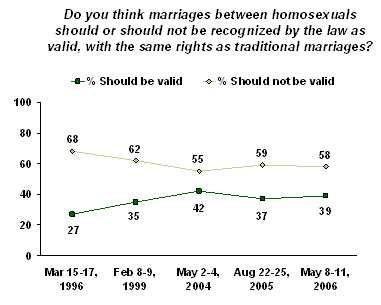
A Gallup poll from March 1996 showed that 68% of Americans disapproved of marriages between homosexuals while 27% were in favor. This polling data was taken during the passage of the Defense of Marriage Act and demonstrates a supermajority of Americans favoring marriage between a man and a woman and believing that only such marriages should be valid.

By 2004 that supermajority had slimmed 13 points to 55% of Americans who indicated disapproval of same-sex marriages. The majority of those 13 points went to the other side, bringing the percentage of Americans in support of same-sex marriage in 2004 to 42%.

Gallup came out with more polling data in 2007 indicating that only 53% of Americans were opposed to same-sex marriage and 46% were in favor. Think about that. A decade passed and support for same-sex marriage grew by 19 points while opposition to it dropped by 15. See the video below for more information.


I believe this is in part where the National Organization for Marriage (NOM) comes from. The “About NOM” section of their website reads:
Founded in 2007 in response to the growing need for an organized opposition to same-sex marriage in state legislatures, NOM serves as a national resource for marriage-related initiatives at the state and local level.


Indeed, a decade of polls were showing strong gains for same-sex marriage advocates. The founders of NOM realized there was no organized group on a national level tackling this issue and informing the public of the importance of preserving marriage between a man and a woman.

It is no surprise then, that Gallup polls from 2008 and 2009 both showed increases in public opposition to same-sex marriage peaking at 57% in 2009 before leveling off at 53% this year. That May 2010 Gallup poll showed that only 44% of Americans support same-sex marriage, a 2-point drop in support since 2007.

It is fair to say that the National Organization for marriage has, at the very least, made the public take a second look at same-sex marriage, which would explain the abrupt halt in decreasing opposition to it, and at the very best, turned the momentum of public opinion around, which would explain the decrease in support for same-sex marriage since 2007.

Considering our report analyzing the impact of the 2010 mid-term elections on the same-sex marriage movement, it is fair to say that the prospects for new legislative efforts to redefine marriage are slim and will remain slim through 2012 when conservatives will be motivated and voting in high numbers (again) in opposition to Barack Obama’s re-election bid.

Chief Justice John Roberts
Therefore, elections that take place over the next couple years are going to bring about victories for conservative candidates, especially those candidates backed by the Tea Party.  Generally speaking those types of candidates are not sympathetic to the homosexual agenda.

Now consider the current conservative lean of the U.S. Supreme Court. The Robert’s Court is unlikely to liberalize anytime in the near future, certainly not before the Court decides the marriage issue in the next few terms.

The question is whether or not this conservative Supreme Court under Chief Justice John Roberts will trump a decade worth of legal victories same-sex marriage advocates have enjoyed in the lower courts. For same-sex marriage advocates, it’s a huge all-or-nothing risk to take.

THEIR STRATEGY IS DOOMED TO BACKFIRE

Especially when public opinion polls indicate fluctuating, yet generally growing support for same-sex marriage over the past decade. American society has become more and more liberal since the 1960’s.

Gallup Poll from December 24, 2009.
Meanwhile, although 78% Americans still claim to be Christians, fewer and fewer Americans understand what Christianity is and were unable to answer basic questions about the Bible in a recent survey conducted by Pew Forum on Religion and Public Life.

Compare that to the 89% of Americans that claimed to be Christians in 1973 and 91% in 1948. Likewise, Atheism has grown by over 150% since that 1978 poll.

CNN published a 2009 article America becoming less Christian, survey finds and wrote: “America is a less Christian nation than it was 20 years ago, and Christianity is not losing out to other religions, but primarily to a rejection of religion altogether.”

It’s not that Americans are necessarily growing more approving of same-sex marriage or the homosexual agenda; it’s just that they just don’t care anymore.

William Donahue, president of the Catholic League attributed the survey’s findings to the growth of individualism, the article reads, and told Lou Dobbs: "The three most dreaded words are thou shalt not… they are saying I don't want to be told what to do with my life."

Now the LGBT community is on the verge of losing it all in the Supreme Court with only their impatience to blame. A 2013 or 2014 Supreme Court decision against same-sex marriage would be devastating to their cause and will set them back decades, regardless of the direction public opinion polls go.

I can very easily see a time in the not-so-distant future when a 2015 Gallup poll, for instance, shows for the first time that a majority (or at lease plurality) of Americans support same-sex marriage. But by then that won’t mean anything because the recently printed Robert’s Court ruling affirming marriage as a legitimate state interest which may be limited to a man and a woman will still have that fresh-out-of-the-printer smell. Have you ever smelled a new book? You know what I’m talking about.

MORALITY IS AWOL

It’s clear as day that America’s moral compass has been knocked around and the calibration has since been thrown off. The moral direction our country is going makes me think of the Perfect Storm movie. The interesting thing is that, according to Real Clear Politics, over 60% of Americans think the country is on the wrong track, too.

And this is, of course, welcome news for gays and lesbians who utter separation of church and state arguments like champion orators. It’s a case of too-bad-for-them, very-good-for-us as even their best orators won’t be able to surmount the looming strength of recent Supreme Court ruling against their cause.
READ MORE - Fighting for same-sex ‘marriage’ through the courts: Short-term gains, long-term failure?

Same-sex Marriage Returns to California... soon.

Thursday, August 12, 2010

Today we learned that Judge Vaughn Walker, who unilaterally overtured millions of votes last week by striking down California's voter-approved Proposition 8, denied the motion to stay his decision while the appeals process takes its course.

However, that doesn't mean that same-sex couples have already started marrying today, although thousands of same-sex couples lined up around the state in anticipation of making August 12, 2010 their wedding anniversary date. From the Judge's decision on the matter of the stay:


"That judgment shall be STAYED until August 18, 2010 at 5 PM PDT at which time defendants and all persons under their control or supervision shall cease to apply or enforce Proposition 8." - Judge Walker's Final Stay Order of August 12, 2010

So what that means, assuming that city halls and courthouses across the state close at 5 PM as most government offices tend to do, is that same-sex couples will not be able to marry until the morning of August 19th. That is essentially an extention of the Judge's original temporary stay by one week.

Now it hasn't been unheard of to see some city halls opening their doors early in order to permit same-sex couples to marry sooner. It wouldn't be a big surprise if some city halls decided to stay open into the evening or night on August 18th in order to allow same-sex couples to marry immediately once the judgement becomes official that Proposition 8 can no longer be enforced.

Proponents of Proposition 8 have already filed their appeal to the 9th Circuit Court of Appeals. Most importantly, the extention of the temporary stay by another week will perhaps give the legal team defending Proposition 8 the time they need to request and possibly recieve an injunction order from the Appeals Court that would effectively maintain the legality of Proposition 8 until said Appeals Court could issue a decision.

Either way, at this point same-sex couples are one week away from being able to marry each other but we will monitor the situation and provide updates whenever possible.

Should same-sex marriage resume in California, in the event that the Court of Appeals does not issue an injuction, then may we only wish that any same-sex marriages that do take place there be successful and bring happiness to our homosexual friends.

UPDATE: (11:25 PM August 16, 2010)

The 9th Circuit Court of Appeals has issued an injunction against Judge Walker's ruling, effectively staying his ruling throughout the appeals process. This means that same-sex marriages will not be taking place in California anytime soon, although many city and county government offices were preparing to stay open late to perform such marriages.

The order itself can be found and read here.
READ MORE - Same-sex Marriage Returns to California... soon.


November 2010

Support Marriage

Sign Our Petition